Brand strategy with Jung’s brand archetypes: the foundation for strong brand positioning
Why do we feel immediately attracted to some brands, while we forget others right away? The secret lies in our subconscious. According to psychologist Carl Gustav Jung, we all make use of universal character structures: archetypes.
For a strong brand, it is essential to truly know yourself and your ideal customer. By consciously embracing one suitable archetype, you give your company a clear and recognizable face. It is the fundamental building block for strong positioning and a brand identity that is not only seen, but also felt.
Jung archetypes
The foundation of archetypes lies in the work of Swiss psychiatrist Carl Gustav Jung. He described them as universal patterns that live deep within our collective unconscious. Whether it is the “Hero,” the “Sage,” or the “Rebel,” we instinctively recognize these characters from stories, mythology, and films.
In the 20th century, this concept was translated into marketing and advertising by pioneers such as Dr. Ernest Dichter. The insight was that consumers build connections more quickly with brands that adopt a recognizable human personality. Today, there are 12 universal brand archetypes that serve as a strategic compass to create a consistent and powerful brand experience.
Archetypes in marketing
An archetype gives a brand an unchanging identity. Through this archetypal projection, a fixed image is created in the subconscious of your target audience: the hero cannot be a loser, and the adventurer cannot be dull. Just like in films and fairy tales, these universal figures instantly evoke the right emotions.
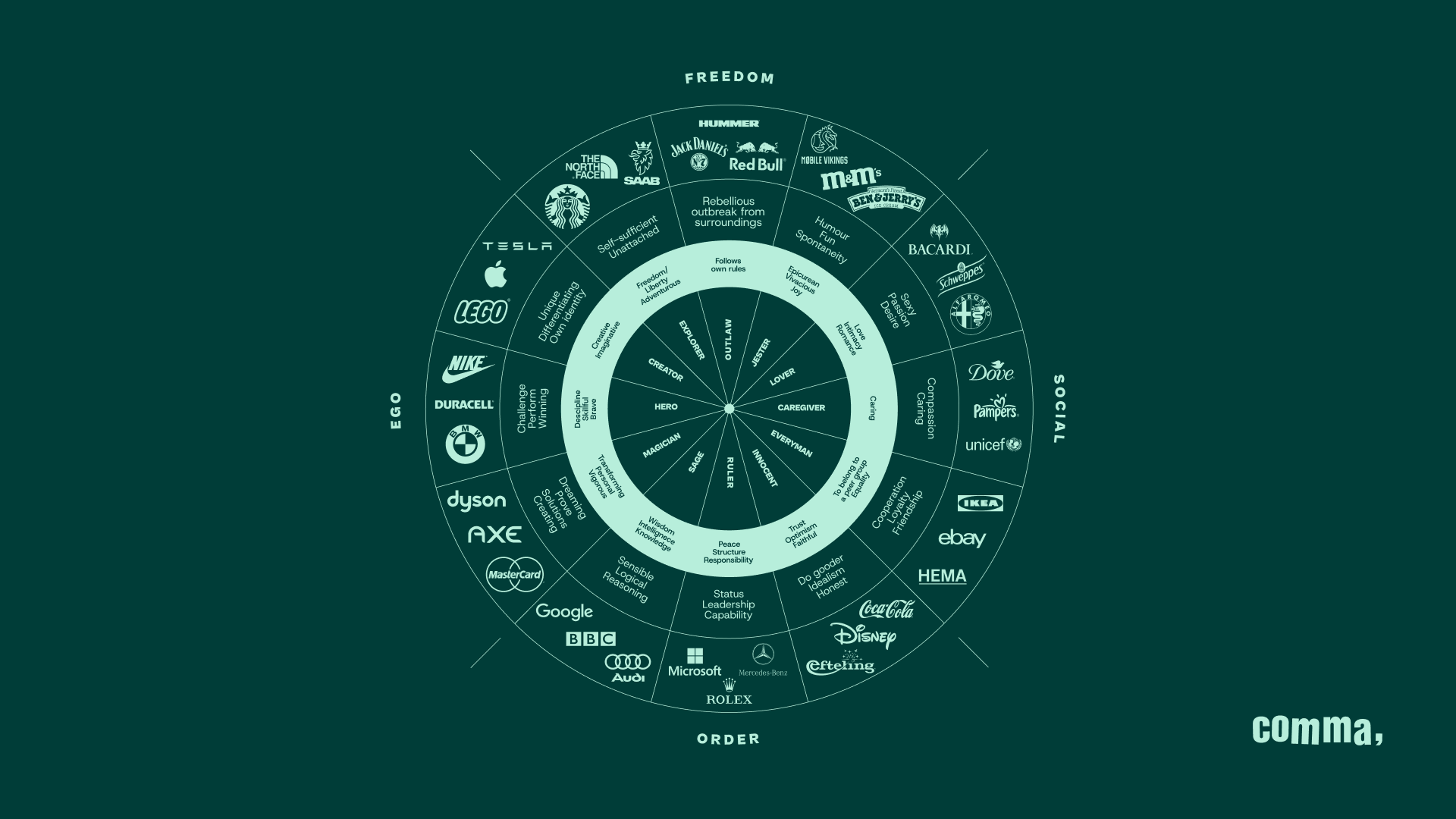
Jung’s principle is therefore essential for marketing and communication. By responding to the instinctive reactions that an archetype triggers, you reach your audience more effectively. However, an archetype should not be chosen randomly. It must reflect the pure authenticity of your brand. The brand wheel (Kapferer’s model) is a useful tool to sharpen your unique communication style.
Brand impact through choice
Once your strategy is defined (Business Model Canvas) and your positioning is determined, the crucial question follows: how will you communicate? The temptation is often to claim a mix of four or five archetypes, but this inevitably leads to noise and lack of clarity. Real impact comes from deliberately choosing one or two of the twelve segments of the brand wheel. It is not an easy task, but it is the path to a love brand. By sticking to a clear archetype, your brand is not only recognized, but your customer is also truly inspired and motivated.
Brand strategy with impact: the power of brand archetypes
Using an archetype goes beyond just a beautiful appearance; it shows who you are, what you stand for, and how you engage with your audience. The goal is to give your brand a human face that is instinctively understood.
By embracing an archetype, you create a foundation for:
- Recognizability: Your target audience immediately senses the essence of what your brand represents.
- Authenticity: The archetype does not act as a mask, but as a powerful reinforcement of your true core.
- Differentiation: A clear choice for one position ensures the necessary focus and consistency in all your expressions.
Strengthening your brand positioning with brand archetypes
Consistently applying brand archetypes offers tangible benefits that strengthen your brand in a saturated market:
- Clarity and consistency: Archetypes provide your team with a shared framework for brand personality, scalable across all channels and campaigns.
- Emotional connection: By tapping into universal stories that resonate on a subconscious level, you transform a functional preference into genuine brand loyalty.
- Unique differentiation: In markets where products increasingly resemble each other, your brand personality becomes the defining factor that sets you apart from the crowd.
- Foundation for storytelling: Archetypes form the engine of your brand story, giving creative teams a clear starting point for campaigns and experiences that always feel coherent.
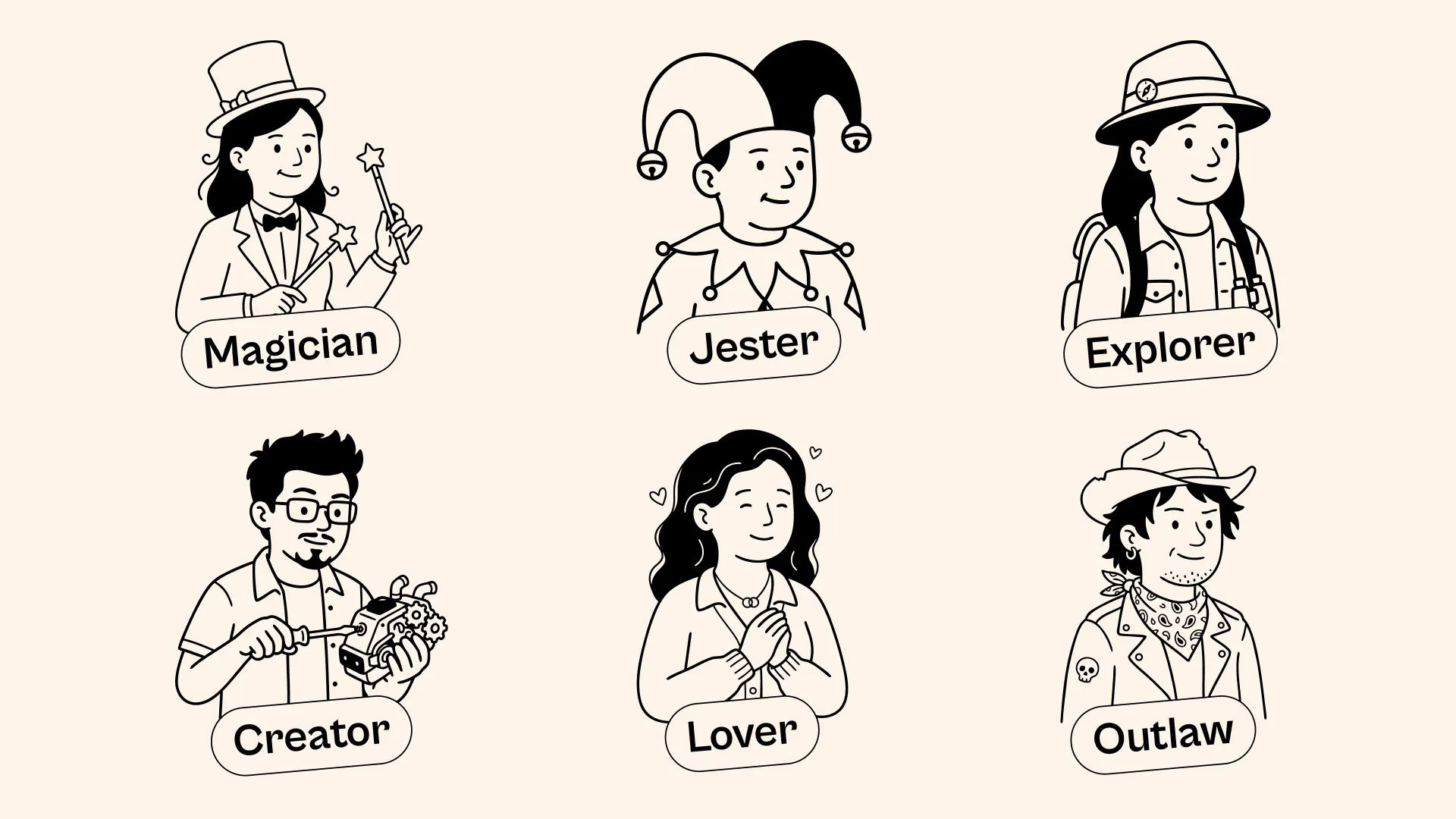
The 12 archetypes at a glance
- Magician
- transforms and inspires (Axe, MasterCard)
- Hero
- courageous and ambitious (Nike, BMW)
- Creator
- creative and unique (Apple, Lego)
- Explorer
- adventurous and free (Lonely Planet, Nikon)
- Outlaw
- rebellious and boundary-breaking (Harley-Davidson, Red Bull)
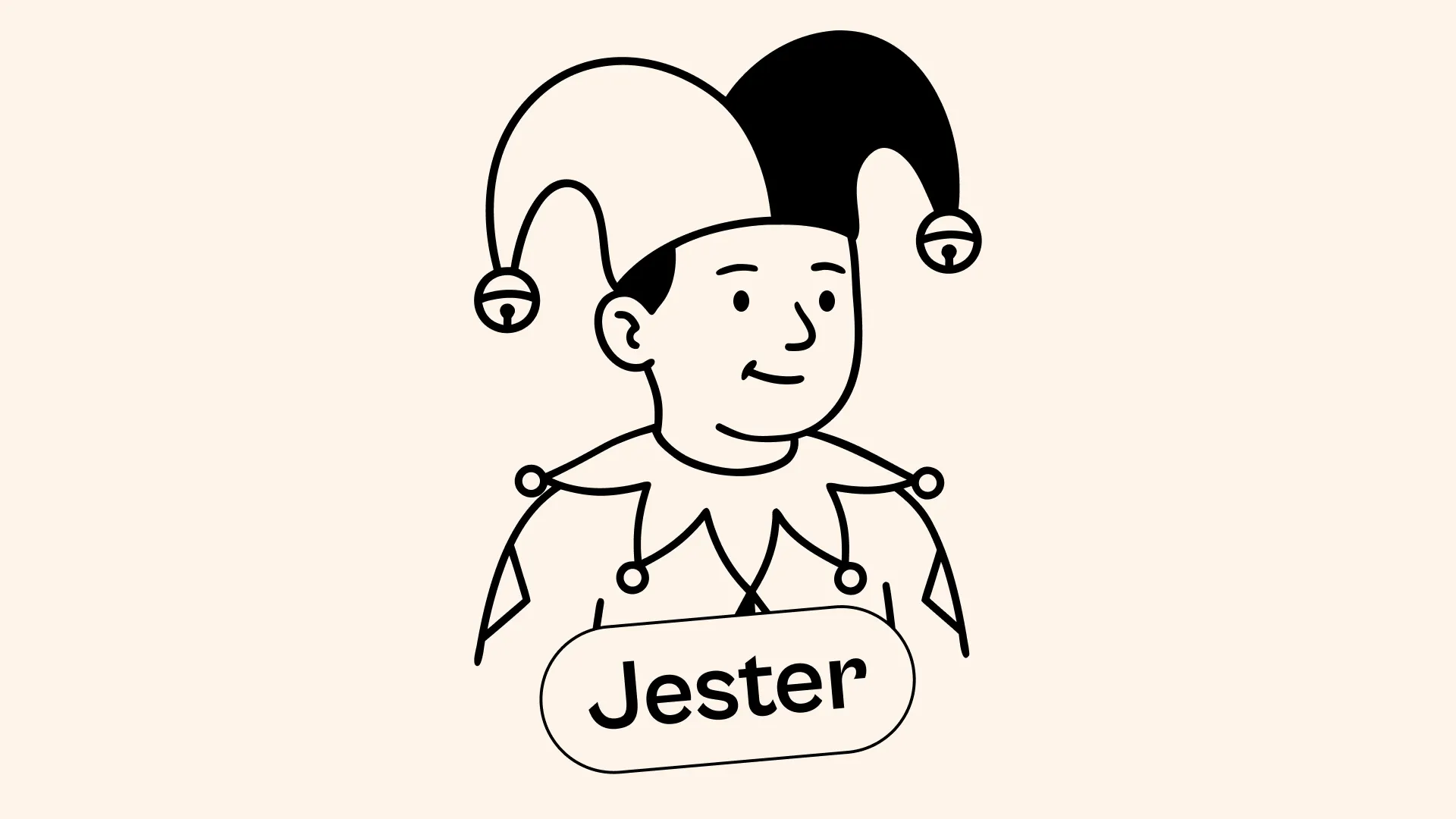
- Jester
- light-hearted and playful (Ben & Jerry’s, Nintendo)
- Lover
- emotional and seductive (Chanel, Magnum)
- Caregiver
- caring and harmonious (Nivea, Pampers)
- Everyman
- ordinary and accessible (Ikea, Hema)
- Innocent
- pure and optimistic (Coca-Cola, Disney)
- Ruler
- structured and visionary (Mercedes, Microsoft)
- Sage
- knowledge and insight (Wikipedia, Philips)
In 6 steps to a unique brand positioning
At Comma, a step-by-step plan is used to determine the most suitable archetype.
Step 1: Navigating through the four quadrants
Get to know the fundamental drivers behind each brand: Freedom, Social, Order and Ego. These quadrants oppose each other and form the first compass for your positioning. Determine which core promise you want to express and see which personalities belong to that quadrant:
- Freedom: Explorer, Outlaw, Jester
- Social: Lover, Caregiver, Everyman
- Order: Innocent, Ruler, Sage
- Ego: Magician, Hero, Creator
Step 2: Selection by elimination
Go through the circle and decisively eliminate the personality types that do not align with your brand. Use the characteristics in the inner circle and the detailed descriptions in the outer ring as a guide to rule out options.
Step 3: Look beyond the surface
Don’t blindly follow examples based on a logo, but analyze the full communication style. What advertisements, visuals and campaigns come to mind when you think of these brands? Focus on external communication to the market and don’t be guided solely by internal company culture.
Step 4: Determine the unique match
Which personality types remain after elimination? Think deeply about these positions and determine which of the remaining archetypes best embodies your brand’s unique personality.
In 2026, Comma goes one step further with Hybrid Branding. We define a primary archetype and a secondary archetype. This layering creates a more human and less predictable connection with your audience.
Step 5: Benchmark the competition
Map your competitors on the brand wheel. Check whether your chosen position is distinctive enough to stand out in the market. By claiming a unique segment, you build an irresistible brand.
Step 6: Steering transformation
Is your company in transition? Then carefully analyze where you stand today and where you want to grow. This provides a clear path for the future and makes your brand evolution measurable and tangible over time.
Brand identity: from archetype to a strong brand
After defining your unique position, it is important to consistently implement it across all levels of the organization or company. This means that the entire communication must be aligned:
form, color, typography, logo, visual style, product and architecture, storytelling, campaign elements, packaging, and adjustments depending on the chosen position, etc.
This method ensures the building of a strong brand based on the right visualization, communication, and performance.
This model guides you step by step toward the essence of your brand: pure, unique and clear, with the right focus in mind.
Communication Strategy
Would you like guidance on brand identity and communication style?