Google Search Console takes first step towards AI reporting in search results
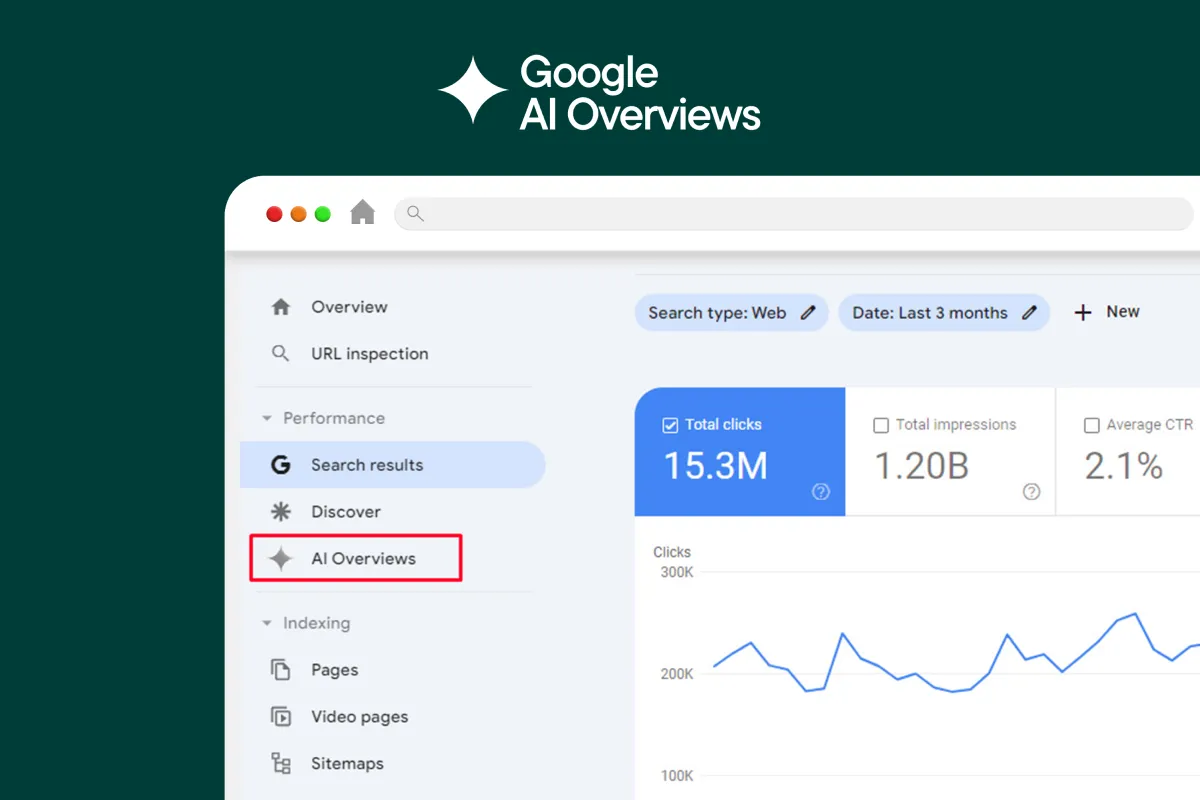
Google is taking a significant step towards AI reporting. Soon, you’ll find a separate section for generative AI search results in Google Search Console, in addition to the standard performance reports. Until now, all of this information was presented in a single large report. This made it difficult to determine whether your visibility came from regular search results, AI Overviews, AI Mode or other AI-driven Google experiences. With the new section, Google is making a clear distinction for the first time.
mportant: the rollout isn’t happening for everyone just yet. Google is initially testing the new AI section with a selection of websites, so you may not see the new type of reports in your own Search Console account just yet. Nevertheless, the direction is clear: AI is no longer a topic for future speculation but is now gradually finding its way into SEO reporting.
What will I be able to measure in the AI report?
The initial version of the AI report is limited. For now, Google only shows how many impressions your pages receive in generative AI search results. An impression means that your page or content was visible in a Google AI experience. This could be via AI Overviews, AI Mode or the AI features within Discover, for example. You will not be able to deduce how many people click through, the specific questions they asked or the prompts that caused your content to be picked up. However, you will gain a first insight into where your content appears. You can further break down these impressions by page, country, device type and date.
That may seem limited, particularly for marketers who are used to reporting on clicks, click-through rate (CTR) and position. But this is precisely where the change lies. In traditional SEO, rankings and traffic are what matter most, whereas in AI search results, visibility, relevance and recognition are also key factors. Your content can be highly valuable in an AI response, even if a user doesn’t immediately click through to your website.
So, are impressions alone sufficient? No, not if you want to measure your full business impact, but they will help you ask better questions. For the first time, you will gain a broader insight into how your pages perform in AI-driven search experiences. You can see which pages are frequently displayed, which topics appear to align with users’ queries and what type of content Google readily picks up for AI answers. And that is indeed valuable information.
How can I use this for SEO and GEO?
Suppose your online guides, comparative articles or clear how-to pages generate a lot of AI impressions. That tells you something about the way Google understands and uses your content. Conversely, suppose your commercial service pages are barely visible. This indicates that there is still some work to be done on the structure, clarity, expertise or context of your pages. For marketing teams, this offers an opportunity to not only see what generates traffic, but also to understand what Google considers useful in an AI context.
The practical approach is simple. As soon as you have access to the new report, start with your top pages. Which pages are getting the most AI impressions? What do those pages have in common? Are they clearly structured? Do they answer specific questions? Do they use clear subheadings? Do they demonstrate expertise? Is it clear who the information is intended for?
Then compare this with pages that are picked up less effectively. You’ll often see patterns emerge. Perhaps pages with clear definitions perform better. Maybe local pages are picked up more strongly when they contain specific local context. Perhaps articles with practical examples work better than general marketing texts.
You can carry out this analysis yourself, or you can ask an AI tool or large language model (LLM) to help you understand why certain pages perform better than others. This provides an additional framework for thinking. If a clear pattern emerges, apply it to your other pages. In this way, you use the new report not as a standalone metric, but as input for better content, stronger SEO and a smarter GEO approach.
The real shift is not just being found on Google, but also being understood, selected and displayed within AI search answers.
Is your brand already featured in AI answers?
With search habits shifting toward AI tools, Comma maps your AI visibility, topical opportunities, and competitor positions. Ready to boost your brand’s discoverability and future-proof your presence? Let's brainstorm together.