Why your Google Ads account is about to get more expensive after August 17, 2026
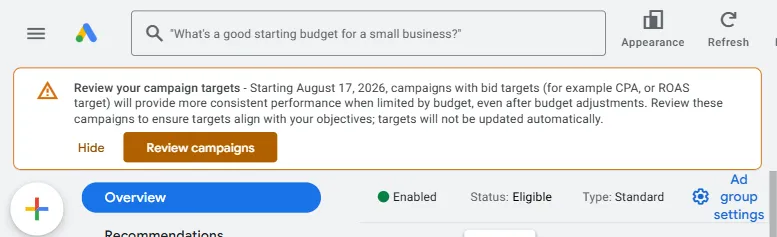
"Review your campaign targets Starting August 17, 2026, campaigns with bid targets (for example CPA, or ROAS target) will provide more consistent performance when limited by budget, even after budget adjustments. Review these campaigns to ensure targets align with your objectives; targets will not be updated automatically."
If you're running campaigns with Target CPA (tCPA) or Target ROAS (tROAS) that are "limited by budget," you've probably been (unknowingly) outperforming the target you set for months. That's no coincidence — it's an inherent feature of how Google's bidding algorithm handles a constrained daily budget. On August 17, 2026, Google is unfortunately removing that feature. For some advertisers, that means stability. For others, it simply means: paying more for less…
What exactly is changing from August 17, 2026?
From August 17, 2026, campaigns that are "limited by budget" and use a target-based bidding strategy (Target CPA or Target ROAS) will bid more consistently toward their set target, even when you adjust the budget. Google presents this as an improvement: more predictable performance, fewer fluctuations when scaling your campaigns.
The Bid Target Adjustment Tool, available in Google Ads since July 6, 2026, is meant to help you review your targets before that date. Google won't adjust anything automatically. If you don't do it yourself, your account will change on August 17 without any action on your part. Not all campaign types are affected: App campaigns, Video reach campaigns, and Video view campaigns are exempt. Nearly everything else running Target CPA or Target ROAS is affected.
The current mechanism: why you're probably performing "too well" right now
This is the part most businesses miss. When your campaign is budget-limited, the algorithm knows your running budget is the ultimate ceiling. Within that ceiling, all-knowing Google hunts for the cheapest possible conversions. Google isn't looking to hit your exact Target CPA (the cost per acquisition you had in mind). If your Target CPA is set at €10, there's a good chance you're actually paying €5, simply because the algorithm is using the budget as efficiently as possible instead of chasing that exact €10 figure. That's great, right up until you raise the budget. At that point the algorithm starts bidding into more expensive auctions and performance fluctuates, unsettling advertisers who'd just gotten used to their "too good" numbers. Google's fix: starting August 17, the target becomes both a floor and a ceiling at once.
What you set is literally what you get — even if that means your conversion volume drops, because you're now entering more expensive auctions to land exactly on your target. A concrete example: a campaign with a Target ROAS of 200% has actually been running at 350% for the past 30 days. Without intervention, that 350% will drift back down toward the set 200% after August 17. The result? Less revenue from that same campaign, simply because the algorithm is now deliberately accepting less profitable auctions to hit your target.
Why this hits small advertisers hardest
Picture a local market with ten competing businesses — say, 9 painters in the Bruges area, all bidding on the same keywords, all budget-limited, all outperforming their own Target CPA. If none of them acts, all 9 will see their CPA creep up toward the set target after August 17. Fewer leads across the board, without anyone touching a single setting. If they all then adjust their targets to match their actual performance (i.e., lower them), relatively little changes — the auction dynamics stay roughly the same. But the moment one competitor decides to raise their target to what they're actually willing to pay, that player becomes more competitive in the auction and starts pulling volume away from the rest. The others feel it and adjust in turn.
That's the mechanism through which this kind of update can drive structural price inflation across a market. Not because Google literally raises CPCs, but because advertisers end up forcing each other to bid more competitively. And here's the pain point: whoever is in the account daily sees this notification, understands the mechanics, and adjusts in time.
Whoever just "lets the ad account run" because it's been performing well (often a smaller business without a marketing team) only notices afterward that cost per conversion has gone up and volume has dropped. This group pays the price for this change the most, and most often without knowing why. But you, at least, now know exactly what's coming 😉!
What does Google say about this change?
What Google itself says: Ginny Marvin, Ads Product Liaison at Google, confirmed the change on LinkedIn in response to questions from the industry: budget-limited campaigns with a target will start behaving the same as campaigns that aren't budget-limited. Anyone who raises their budget afterward can expect more stable performance as the campaign scales. Google is rolling out in-account notifications so advertisers and agencies can review historical performance and adjust their targets in time.
If you want to scale your campaigns, stability works in your favor. You absolutely want consistent performance. But with changes like this, we always ask ourselves: who does this really serve — the advertiser or Google? Because more stability here also means more bid budget flowing into more expensive auctions, and more revenue for Google.
What to do now: protect your results before August 17
This update only affects campaigns that are structurally "limited by budget" and use a target-based bidding strategy. Campaigns that aren't budget-limited are unaffected. So first check which of your campaigns fall into that category, then choose one of two paths.
- Happy with your current overperformance? Raise the budget. That way you capture extra volume at a CPA or ROAS close to your current, strong results.
- Prefer to hold onto your current performance without raising the budget? Move your target gradually!!! Not all at once!!! Step it toward your actual 28-day performance. Jumping from 200% to 350% tROAS in one move is unstable; nudging it up in small weekly steps works better.
Do nothing, and the scenario is simple: your target gets hit, but at lower volume and a higher cost per conversion than you're used to. Exactly what Google is promising to deliver starting August 17.
Never get blindsided by a Google update again?
This change is just one example of something that happens constantly: platforms like Google Ads update their rules, often without you noticing right away — until your results make it impossible to ignore. At Comma, we track these updates closely 😉.
Want a performance agency that already knows what's changing before August 17, adjusts your targets in time, and doesn't let you pay for an update you never saw coming? Feel free to get in touch. We'd love to think it through with you.
In this article
By Tamara Plancke, performance marketeer Comma, brandstrategists
Google Ads expert
Comma is a certified Google Partner. This recognition confirms our expertise in Google Ads and demonstrates that we set up and optimize campaigns according to Google's quality standards. We translate data and insights into concrete optimizations that lead to more high-quality leads, sales, and a maximum return on your advertising budget.